



Virtual Field Trips
Digital field trips expand access, capture place, and put agency in learners' hands. Our Virtual Field Trips program builds the tools and frameworks to make that happen through immersive, 360° navigable worlds.
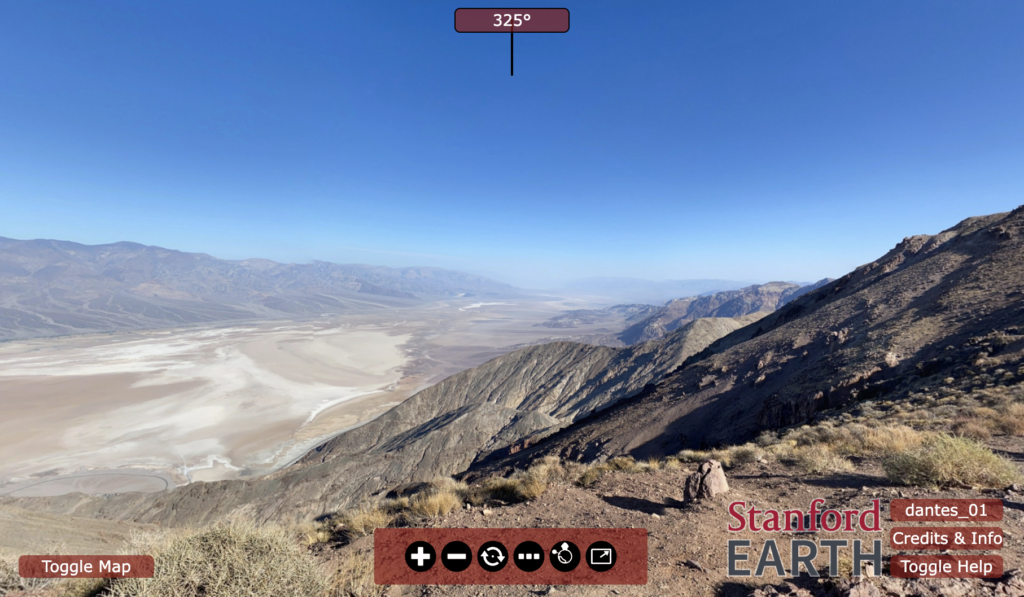
Virtual field trips (VFTs), which take many forms, let learners engage with a location in a digitally mediated way, often without traveling there. VFTs can broaden access to locations and experiences and help mitigate inequities due to cost, accessibility, or inclusivity. Advances in technology have reduced barriers to creation, giving educators and students opportunities to become content creators and embed learning in locally or personally meaningful contexts.
Yet, the science behind designing engaging, effective virtual field trips lags behind technological growth. Virtual field trips can support learning by increasing learner connectedness, whether to the land, a phenomenon, or other people. This program explores and promotes virtual field trips to support meaningful learning.
In action
Virtual field trips offer unique affordances to expand access to locales, capture sense of place, and foreground agency within an experiential learning environment.
Resources for educators and students
The VFT Photosphere Camera, built by the Accelerator Studio, is a tool that can help create fun, interactive adventures that can help educators and learners ground learning in new places. The tool uses your phone’s gyroscope to make 360° photospheres with a guided capture system.
Research and innovation grants
To date, we have funded 14 proposals representing six of Stanford’s seven schools. Through this work, we are building an interdisciplinary community at Stanford interested in advancing learning through virtual field trips and exploring new models for teaching with VFTs in domains ranging from ecology to civil engineering to music.
Seed grant
The Science and Design of Virtual Field Trips
Funded concept-proving research and designs that advance learning in the area of virtual field trips.
Learn more: The Science and Design of Virtual Field Trips
Related stories
Artificial intelligence
How technology is reinventing education
Stanford Graduate School of Education Dean Dan Schwartz and other education scholars weigh in on what’s next for some of the technology trends taking center stage in the classroom.
Read the story: How technology is reinventing education
Announcements
New round of seed grants to support design and research of virtual field trips
Faculty, staff, and students across all disciplines are invited to propose concept-proving research and designs that will advance learning in the area of virtual field trips.
Read the story: New round of seed grants to support design and research of virtual field trips
Related grants
Seed grant
The Science and Design of Virtual Field Trips
Funded concept-proving research and designs that advance learning in the area of virtual field trips.
Learn more: The Science and Design of Virtual Field Trips
Faculty leads

Dan Schwartz
The Halper Family Faculty Director, Stanford Accelerator for Learning and Faculty Director, Digital Learning Initiative
View profile: Dan Schwartz
Bryan Brown
Professor
Research team
- Kristen Pilner Blair Director of Research, Digital Learning Initiative
- Keith Bowen Director, Learning Design Challenge
- Catherine Chase Research Director, AI + Education
- Doris Chin Senior Research Scholar, Graduate School of Education
- Ryan Petterson Director of Field Education, Doerr School of Sustainability
- Ana Saavedra Postdoctoral Scholar, Graduate School of Education
- Joe Sherman Digital Media Producer, Graduate School of Education
- Kendra Sobomehin Doctoral Candidate, Graduate School of Education
- Reuben Thiessen Project Management Specialist, Stanford Accelerator for Learning
- Wilson Wang Assistant Director of Data Science & Cloud Architecture, Graduate School of Education
- Josh Weiss Director of Digital Learning Solutions, Graduate School of Education
- Rachel Wolf Social Science Research Scholar, Graduate School of Education