

Assessment
New online tool helps identify struggling readers
Jason Yeatman, director of the Brain Development & Education Lab and an affiliate of the Stanford Accelerator for Learning, has developed a highly efficient tool for screening students with reading difficulties.
By Carrie Spector
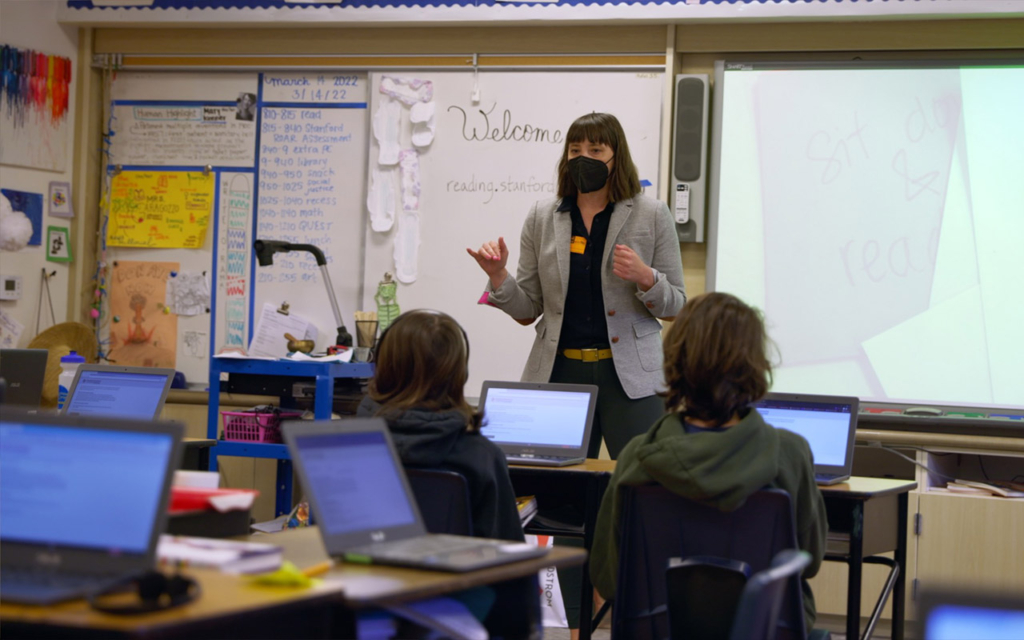
Identifying struggling young readers can be a time-consuming and costly task for schools, requiring a teacher or reading specialist to sit with students one-on-one to gauge their proficiency as the child reads aloud.
A new online tool developed at a Stanford lab lifts that burden without compromising any of the reliability of one-to-one assessments while advancing research into why some kids have trouble with reading in the first place.
The Rapid Online Assessment of Reading (ROAR), developed at the Brain Development & Education Lab at Stanford, introduces a way for school districts to assess their entire student population for struggling readers in the time it currently takes to run a standard assessment on a single student.
In addition to giving teachers useful insight into the challenges a particular student faces, the collective data generated by the assessment is helping to further the lab’s research into factors linked to learning differences in young readers.
“With the ROAR, schools and clinics can assess and monitor kids’ progress at a scale that just wasn’t possible before,” said Jason Yeatman, an assistant professor at Stanford Graduate School of Education (GSE) and the School of Medicine, who directs the Brain Development & Education Lab. “And because the tool is tied to research that’s ongoing, it gives us data that can answer a lot of questions about the mechanisms of reading development – data that can help us understand why some kids struggle and others don’t.”
More stories
Research
Autistic teens ‘tune in’ less to new voices
A new Stanford Medicine study finds differences in how autistic teens process unfamiliar voices, pointing toward new therapies for adolescents.
Read the story: Autistic teens ‘tune in’ less to new voices
Research
Dyslexic children show differences in brain reading region
A new study reveals that the visual word form area, vital for text recognition, is smaller or absent in dyslexic children. Intensive reading intervention can help.
Read the story: Dyslexic children show differences in brain reading region
Future readiness
Intellectual disabilities and college: Envisioning bright futures
“Presumed competence” can improve learning outcomes for students with intellectual and developmental disabilities, says Christopher Lemons, faculty director of the Learning Differences initiative, on the latest episode of the School's In podcast.
Read the story: Intellectual disabilities and college: Envisioning bright futures