



Learning Differences and the Future of Special Education
AI + Learning Differences: Designing a Future with No Boundaries
A report from the Stanford Accelerator for Learning outlines how tech developers, researchers, teachers, and policymakers can ensure AI tools serve all learners.
By Nneka J. McGee, Elizabeth Kozleski, Chris Lemons, Isabelle Hau
Download
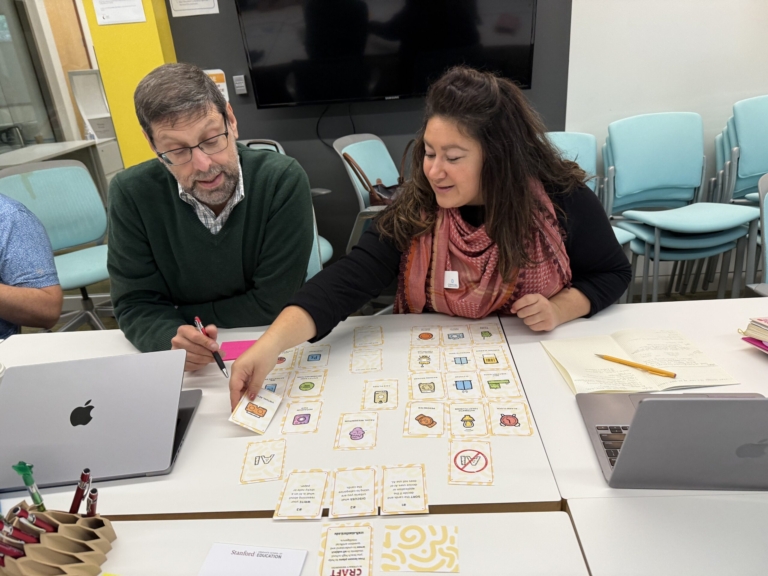
The rapid expansion of artificial intelligence (AI) presents an unprecedented opportunity to address learning differences when designing innovative systems. In December 2024, the Stanford Accelerator for Learning convened the AI + Learning Differences Working Symposium and AI + Learning Differences Hackathon, bringing community members together to explore how AI systems can expand learning opportunities for all. This white paper synthesizes contributions into nine interconnected sections, each examining a critical dimension at the intersection of AI and learning differences:
- Ensuring Co-Design and Collaboration highlights the importance of involving individuals with learning differences, including children, youth, and families, in every stage of developing powerful tools that adapt to individual needs.
- Designing Learning for the Edges analyzes how AI systems can be developed to enable flexible, personalized learning environments that respond to the full range of student strengths and circumstances.
- Special Education and IEPs focuses on how AI-powered tools can enhance individualized education through real-time feedback, scaffolding, and adaptive tools.
- AI in Needs Identification and Mediation Design examines the role of AI systems in early screening, identification, and designs for responsive strategies, raising both opportunities and ethical considerations.
- Supporting Social and Emotional Well-Being with AI considers how technology can be designed to recognize and respond to students’ emotional and social development, which are both vital to learning and long-term well-being.
- AI as Assistive Technology looks at the transformative potential of AI systems to enhance or extend existing assistive tools, empowering greater agency and independence.
- AI in Career-Long Teacher Education explores how AI systems are designed to enhance educator development, personalize professional learning, and promote inclusive pedagogy at every stage of a teacher’s career.
- AI in the Workforce addresses how to equip the full range of learners for a future shaped by AI and automation, emphasizing inclusive access to enriching work.
- AI, Interdependence, and Life Satisfaction broadens the conversation beyond school and work, focusing on how AI can be programmed to foster autonomy, community, and overall well-being across a lifetime.
Accompanying these insights, the AI + Learning Differences Hackathon Toolkit provides practical resources to facilitate co-design and collaboration among community members.
Based on emerging themes, there are 12 actionable recommendations divided into four key groups:
- Developers are encouraged to engage in ongoing, compensated co-design with individuals whose lived experiences offer critical expertise, using learner variability, Universal Design for Learning (UDL), and ethical data practices.
- Researchers should focus on long-term studies that center fairness, accessibility, and authentic learner experiences.
- Educators require robust professional learning that integrates AI systems effectively into teaching and leadership practices, enabling deeper engagement and more responsive instruction.
- Policymakers are advised to consider cross-sector collaboration and develop conditions that promote strategic investment in inclusive innovation, ensuring readiness for future societal demands.
Together, these insights and recommendations inform a cohesive strategy for leveraging AI systems to shape a future where all learners can thrive without boundaries.